The Old Information Board with the Changed Address:
(Stalin Ave., Ožeškienė St. No. 15)
This heavily rusted board hung empty; our names appeared after a dinner with neighbors.
During the interwar period, with the onset of Stalin’s regime, these boards could be found in almost every larger courtyard.
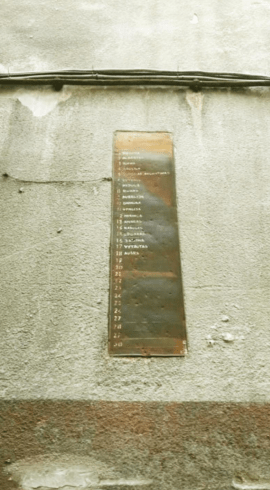
Information boards were hung to facilitate the search for wanted residents. During the repressions, the aim was to quickly find people who needed to be arrested and deported. However, as disappearances became more frequent, such boards stopped helping; on the contrary—they exposed the regime’s activities. Therefore, the boards were banned, ordered to be taken down, but in the “Yard,” it remained.
The old information board still reminds us of who Stalin was and his regime, but most residents of Kaunas and tourists do not know who Ožeškienė was or why her name is immortalized in the street’s name.
For many people of Kaunas, it will be interesting to learn that the street was named after her in 1919, replacing what was then Kurovska Street (data provided according to M. Balkus’s publication “Kaunas Street Names 1918–1940” in the Kaunas History Yearbook).
The author notes that “as the history of the city of Kaunas shows, it was rare for a city’s street to preserve its name from the time of its inception. In the 20th century, most streets in the central part of Kaunas changed their names at least 3–4 times, that is, almost every time the political system in the country changed.”
So who was Eliza Ožeškienė?
Eliza Paulauskaitė-Ožeškienė-Nagorskienė (Polish: Eliza Pawłowska-Orzeszkowa-Nahorska, June 6, 1841 – May 18, 1910) was a writer, novelist, critic, publicist, and social activist. She was born in present-day Belarus, lived for a long time in Liudvinavas and Grodno, and often visited Druskininkai, Panemunė, and Vilnius. The writer signed her works with the pseudonyms Gabriela Litwinka and Li…ka (Lika).
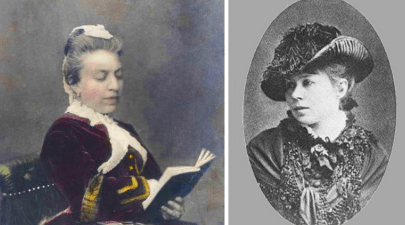
Representing Polish culture, Eliza Ožeškienė also felt an attachment to her native land. Lithuania was her homeland; here lived the nation of which she felt a part, even though she did not speak or write in Lithuanian. The writer did not associate the language used in daily life and creativity with national identity, which she perceived according to the region where she was born and lived—the lands of the former Grand Duchy of Lithuania. She actively participated in the 1863 uprising: she transported mail and food to the insurgents, cared for the wounded, and hid the uprising leader Romuald Traugutt in her manor….
„I truly know that I have not visited this city, but I feel… I have been here before.”
In this project, a wall painting based on the phenomenon of déjà vu is presented, depicting the portrait of Eliza Ožeškienė, who had not visited the city of Kaunas.
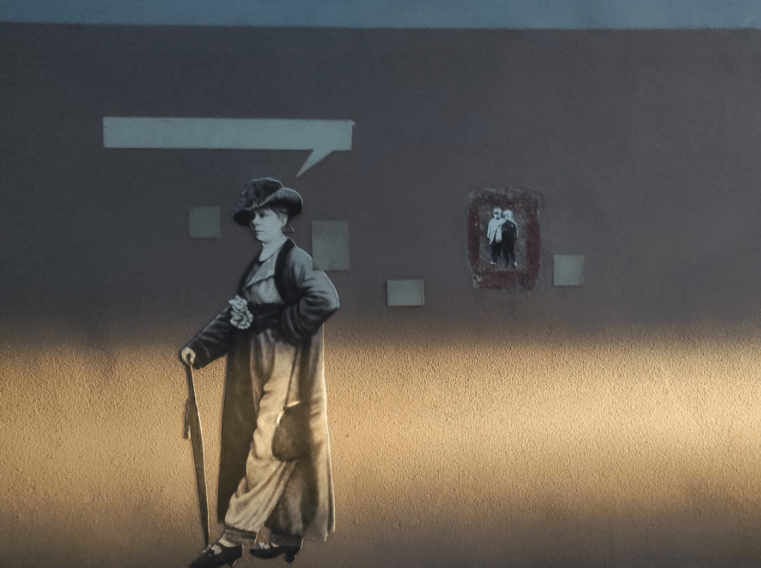
The concept of the project is based on the principles of site-specific art: on one hand, the street art piece draws attention to places people no longer notice—in this case, a street name very well known to residents of Kaunas and visitors to the city; on the other hand, it raises the question—who was the woman after whom, it turns out, this Kaunas street has been named for more than a hundred years.
The Portrait of Eliza Ožeškienė was created in 2024. The work was sponsored by Kaunas Accents.
 Kiemo Galerija