
In Dita’s room, we travel back to the 1920s, when a young Jewish girl, Dita, in love with her neighbor Ika, would, in the evenings, after turning off the light, look at the window of the house opposite, hoping to see him… The past and the present, the Holocaust that forever separated the lovers, and a love stronger than death… An elegant elderly woman, looking toward the oval mirror window on the opposite wall—the same girl Dita, who in the work has become a shadow of her older self. The mirror window reflects the present, but in it are also shadows of the past, recurring events, places, flows of thoughts. Two periods of a woman’s life—youth and old age—which are symbolized by the hoop and the cane held by Dita. In the room, numerous empty frames on the walls seem to pose a question—do we keep all memories, will we find what we left behind when we return in a circle, or do we return the same…
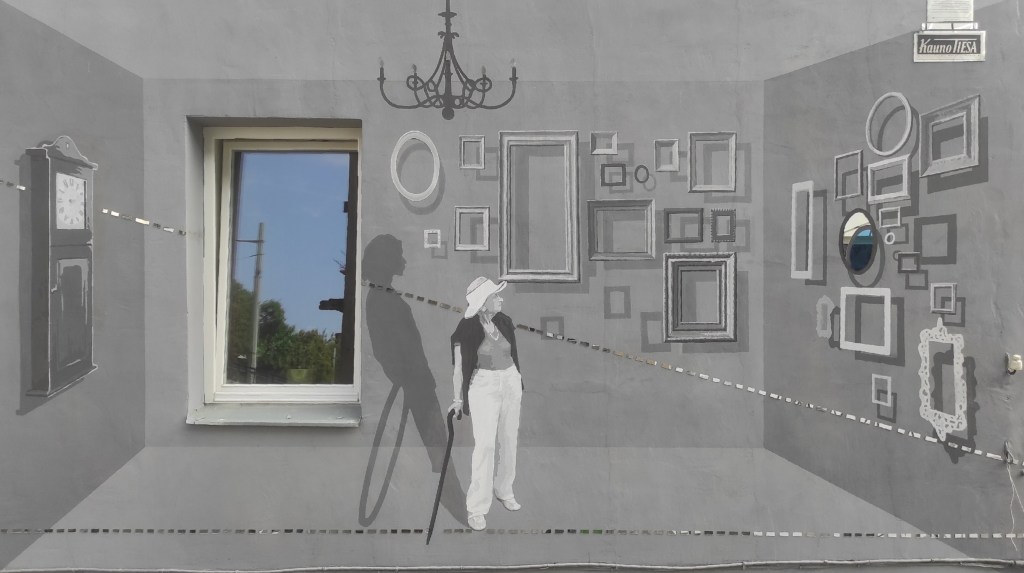
The frames mark the boundaries of the painting, but in the work, the idea of liberation from the past, memories, attachments is questioned, simultaneously raising the question about the hope of eternal life—we are like picture frames, guarding the spiritual world invisible to outsiders, painting the pictures of our lives visible only to us, which perhaps will become meaningful only in the face of eternity. In the room, the shadow of a girl looking toward the mirror window reflecting the clouds and sky guards her secret of love and still knows so little… The eyes of an almost 100-year-old woman looking toward the same window see the same clouds and sky, and the clock behind her counts the minutes and seconds… After almost 100 years, Dita’s room became the windows of neighbor Saulė’s apartment… Although Dita and Saulė have never met, love, faith, and hope are the secret of the windows of their homes…
 Kiemo Galerija